ChemistrySelect (2026) 11(35): e74508. https://doi.org/10.1002/slct.74508
Green Synthesis, Antibacterial Activity, and Molecular Docking Study of γ-Phosphonyloxime Derivatives
Wahbi, A.; Mhamdi, A.; Tahri, W.; Dridi, I.; Dridi, M. A.; Kamisky, W.; Kaabi, K.; Chatti, A.; Nasr, C. B.; Cavalier, J.-F.; Touil, S.
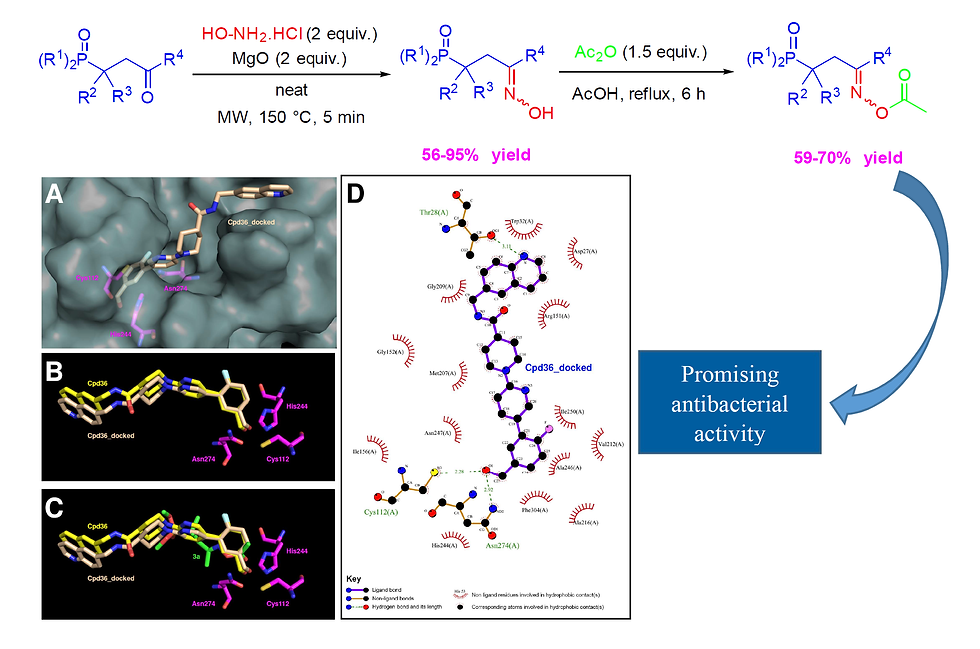
Herein, we report an efficient, fast, and green approach to synthesize γ-phosphonyloximes (2) via microwave-assisted oximation of γ-phosphonylketones under solvent-free conditions. This method achieved high yields (up to 95%) in just 5 min. Subsequent O-acetylation of these oximes yielded novel O-acetyloxime derivatives (3). Structural characterization of all the synthesized compounds was performed using FT-IR, NMR (1H, 31P, and 13C), mass spectrometry, and x-ray crystallography (for 2a), confirming their configuration as mixtures of E/Z isomers with predominant E-forms. The antibacterial activity was evaluated against Gram-positive (Staphylococcus aureus) and Gram-negative (Escherichia coli, Pseudomonas aeruginosa, and Salmonella typhimurium) strains. The O-acetylated compounds (3) exhibited superior activity compared to their oxime precursors (2), with 3a identified as the most potent agent (MIC = 20–40 µg/mL). Molecular docking studies against E. coli FabH enzyme revealed that 3a binds deeper in the active site (binding energy: −5.5 kcal/mol) near the catalytic Cys112 residue, while 2a binds peripherally (−4.8 kcal/mol). This computational insight corroborates the enhanced antibacterial efficacy of 3a and suggests FabH inhibition as a potential mechanism.